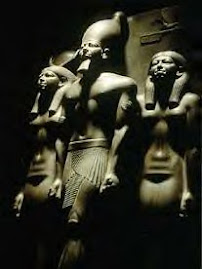
Nubian Moor Race

Nubian Moor Race

Nubian Moor Women

Nubian Moor Women

Sunday, August 14, 2005

Karma


Shem Hotep ("I go in peace")


Karma should be understood as "Cause and Effect." That's what it
is. It doesn't mess with freewill because it doesn't take away
someone's choice to do an action. It is a simple law of cause and
effect and people use the term out of context and thus the
confusion. In Ta-Merri the concept was called "Ari."

Now, the African concept of reincarnation basically states that we
are essentially spirits who are put on Earth to have "experiences."
In our state of perfection in the spirit world, it gets kind of
boring, so we vouch to come to this realm and have experiences. Now
when we come to this plane of existence, we are given certain gifts
that enable us to triumph over the adversities that are set up to
teach us lessons.

It's like being born with some nails, hammer, wood, plumbing,
bricks and glass for windows: it is up for you to discover the
blueprint and build the house. You are born with the gifts, they
are just dormant until you discover who you are and your purpose.
This is the reason behind the numerological charts: to give you
some insight into your naturally born gifts and what you could do
with them to benefit you.

This doesn't mess with freewill as you can either choose to enhance
and uitilize your skills or not use them. To help you with the
opportunity with enlightenment, certain people are situated
strategically with their own gifts to help guide you to that
pinnacle point of self realization.

I, for one, under the Yoruba system of spirituality have as my head
(energy pattern that governs my existence - or gifts given at
birth) the Orisha (god, energy pattern) Eshu. This Netcher deals
with connection and path direction. I have been instilled the gift
of helping people get to where they need to go spiritually. I have
been entrusted with a personality and talent level that allows me
to reach a large group of people and affect their lives to some
degree. This large network (which is still growing) allows me to
introduce people who need to meet for some other spiritual purpose
that I don't know.

But I, in modern concepts, would be a Web Server. A server holds
all of the information and connects people to their given
destination (what ever webpage they desire to visit and the
information it holds). So when it comes to relationships, you are
given gifts and personality traits that are compatible with some
and imcompatible with others.

This allows the right mix of characteristics to come together so a
greater purpose can be fulfilled if the two choose to do so.
Elements in the periodic table come with compatibility
characteristics already mixed in its make up. But it can only join
with certain other elements based on its electron positioning.
Anyway..

We just keep coming back to have different experiences as human
beings. Each with a different lesson to be learned and if you
didn't learn it the first time, you are returned in an environment
which will help you to learn that lesson if you pay attention

Sunday, July 31, 2005

Classism is worst than Racism for Black`s in America. (The Unspoken ISM)

Photobucket

Photobucket

Shem Hotep ("I go in peace").

Photobucket

Classism is worst than Racism for Black`s in America. (The Unspoken ISM)

We live in the wealthiest country in the world, but the greatest percentage of that wealth is in the hands of a tiny percentage of the population. It is environmentally and technically possible for everyone to enjoy a good standard of living if wealth were redistributed, exploitation ceased and the arms race abandoned. The inequitable distribution of wealth prevents the whole society from enjoying the full benefits of people`s labor, intelligence and creativity and causes great misery for working class and poor people.

We have all heard of and discussed racism, sexism, homophobia and many other forms of bigotry, but one thing we have left out of the discussion is the poor. Why are the poor getting poorer while the rich are getting richer? This appears to be a fundamental problem in America today for a number of reasons all of which hinge on the simple question, "If we are the land of opportunity, then why don`t the poor get opportunities?" This is a question of education, families, community involvement, job placement, and much more.

To look closer at this problem we notice that the inner city schools are consistently lower standardized test scores than the private or suburban public schools. With just this one indicator we have a number of problems we must face. Maybe the quality of education is lower. If this is the case we have to ask why. In many areas of America, only a small portion of the schools funding comes from the federal government, most comes from local property taxes. This makes it clear how the inner city school would have fewer resources. The poorer neighborhoods have lower property values, so they collect fewer taxes and have fewer resources. Inner city students also face problems of gang violence and drugs at a completely different level than any other type of school. For example, take the existence of metal detectors at the junior high schools so that kids don`t enter school with knives and guns. Another common rule at inner city schools that are prone to violence is the abolition of book bags because you can conceal a great many things in a book bag. These are all little things that point toward a larger more menacing problem. What is happening to the poor?

Classism: Can be a term formed by analogy with racism is any form of prejudice or oppression against people who are in, or who are perceived as being like those who are in, a lower social class (especially in the form of lower socioeconomic status) within a class society. Classism also refers to the ideology behind class conscious peoples. Often time’s anarchists and communists refer to themselves as classists. The classism carried by the ruling class is that of prejudice, and is often seeded in capitalists. Capitalists regard members of the working class to be lower than those people who are members of the ruling class. Classism is also found consistently in most areas of bourgeois culture.

Racism: Refers to beliefs, practices, and institutions that negatively discriminate against people based on their perceived or ascribed race. Sometimes the term is also used to describe the belief that race is the primarydeterminant of human capacities, or that individuals should be treated differently based on their ascribed race. There is a growing, but controversial, tendency to state that racism is a system of oppression that combines racist beliefs - whether they be explicit, tacit or unconscious - with the power to have a negative impact on those discriminated against on a societal level.

Photobucket
AN HISTORICAL DEFINITION OF “WHITE”

The term white as applied to people was first used by slave—owning colonialists in 17th century Maryland and Virginia to describe poor indentured servants who came from Europe. Originally, these servants had been called “Englishmen,” “Irishmen” or “Christians,” but the colonial ruling class began to use the term “white” to distinguish European servants from African ones, who were often called “Negro,” which means “black” in Spanish. The Virginia legislature made the term “white” a legal distinction in 1791, after a series of joint rebellions by European and African servants, culminating in Bacon’s Rebellion of 1676, nearly brought down the colonial rulingpowers.

Some examples of specific types of alleged racism.

Eurocentrism - the sometimes unconscious practice of historically and culturally focusing on white Europeans, to the exclusion of study, or even mention of, significant achievements of other groups of people.

White flight - the practice of white residents abandoning a neighborhood or area due to the arrival of black or other residents, often decimating the tax base and reducing public services. The practice is also known as the tipping point.

White supremacy - the belief that Caucasians are, as a race, superior or worthy of supremacy, even called by some the "master race". Attitudes of suburb and gated community developers, who are often accused of pandering to racist views by emphasizing "crime risk" in more racially diverse downtown’s, especially in North America.

Aryan Nations - a group of militant white supremacists.

Ku Klux Klan - a group of American white supremacists, founded after the Civil War.

Sunday, July 24, 2005

Bling, Bling - The Murder of Our People Part 2.

Photobucket

"A proud heart can survive a general failure because such a failure does not prick its pride.” African Proverb

Photobucket

Shem Hotep ("I go in peace").

Photobucket

Photobucket
Post-traumatic stress disorder or Posttraumatic Slave Syndrome.
The African American slavery experience has involved every possible cause for post-traumatic stress disorder, or Posttraumatic Slave Syndrome.

Photobucket
Bling, Bling - The Murder of Our People.

Photobucket
The "Bling" Has Got to Give. Their Own COM modification”. If a picture is worth a thousand words, this picture might be a mini novel.
Photobucket
The "Bling" Has Got to Give.

USA Today article on Black spending habits. Alarming but not surprising!

These are tough economic times, especially for African-Americans, for whom the unemployment rate is more than 10%. Alarmingly, rather than belt-tightening, the response has been to spend more. In many poor neighborhoods, one is likely to notice satellite dishes and expensive
new cars.

According to Target Market, a company that tracks black consumer spending, blacks spends a significant amount of their income on depreciable products. In 2002, the year the economy nose-dived; we spent $22.9 billion on clothes, $3.2 billion on electronics and $11.6 billion on furniture to put into homes that, in many cases, were rented. Among our favorite purchases are cars and liquor. Blacks make up only 12% of the U.S.population, yet account for 30% of the country’s Scotch consumption.

Detroit, which is 80% black, is the world’s No. 1 market for Cognac.
(Embarrassing)

So impressed was Lincoln with the $46.7 billion that blacks spent on cars that the automaker commissioned Sean "P. Diddy" Combs, the entertainment and fashion mogul, to design a limited-edition Navigator replete with six plasma screens, three DVD players and a Sony PlayStation 2. The only area where blacks seem to be cutting back on spending is books; total purchases have gone from a high of $356 million in 2000 to $303 million in 2002. This shortsighted behavior, motivated by a desire for instant gratification and social acceptance, comes at the expense of our future.

The National Urban League’s "State of Black America 2004" report found that fewer than 50% of black families owned their homes compared with more than 70% of whites.According to published reports, the Ariel Mutual Funds/Charles Schwab 2003 Black Investor Survey found that when comparing households where blacks and whites had roughly the same household incomes, whites saved nearly 20% more each month for retirement, and 30% of African-Americans earning $100,000 a year had less than $5,000 in retirement savings. While 79% of whites invest in the stock market, only 61% of African-Americans do. Certainly, higher rates of unemployment, income disparity and credit discrimination are financial impediments to the economic vitality of blacks, but so are our consumer tastes. By finding the courage to change our spending habits, we might be surprised at how far the $631 billion we now earn might take us.

Sunday, July 17, 2005

Queen Nefertiti and King Tutankhamun ture face REVEALED.

Photobucket

"As the dog said, 'if I fall down for you and you fall down for me, it is playing.' African Proverb

Photobucket

Shem Hotep ("I go in peace").

Photobucket

Photobucket
The Ankh is defined as the symbolic representation of both Physical and Eternal life. It is known as the original cross, which is a powerful symbol that was first created by Africans in Ancient Egypt.

Photobucket
Cecil B. DeMille, The Ten Commandments. One of the biggest lies ever told.

Photobucket
Anne Baxter as Nefertiti in the Ten Commandments.

Photobucket
Nefertiti, her name, meaning, “The beautiful (or perfect) woman has come”.


THE TURE FACE REVEALED.
Thanks to Egyptian artists, we know what Nefertiti looked like. But how do you put a face on a vandalized, anonymous mummy that was buried some 3,400 years ago? Forensic scientists have done just that, re-creating the face of the mummy Queen Nefertiti.
Photobucket
For more information on this see Nefertiti Resurrected on the Discovery Channel.
Photobucket

Egyptian King Tutankhamun.
Photobucket

A fiberglass bust that purportedly shows the true face of ancient Egyptian King Tutankhamen went on display at London’s Science Museum. The likeness was crafted as part of an investigation into how the teenage pharaoh died more than 3,000 years ago. The fiberglass cast of Tut`s head, based on computer models generated from 1969 X-rays of his mummified corpse, shows an attractive round-headed youth with full lips. But it bears little resemblance to the golden funeral mask found in the pharaoh’s tomb.
Photobucket
For more information on this see THE ASSASSINATION OF KING TUT on the Discovery Channel.

Sunday, July 10, 2005

HOW TO SURVIVE THE LONG ARM OF THE LAW.

Photobucket

"The path is made by walking." African Proverb

Photobucket

Shem Hotep ("I go in peace").

Photobucket

Photobucket


Photobucket
THE NATION`S ONLY BOOK SPECIFICALLY WRITTEN FOR AFRICAN-AMERICANS ABOUT HOW TO SURVIVE THE LONG ARM OF THE LAW.

FIGHTING FOR YOUR LIFE is the book that every African-American household should have. This comprehensive guide will show you how the criminal justice system affects men, women and children who are born African-American in the United States of America and will teach you how to make the right choices to help you survive on your journey through life.
Fighting For Your Life will teach you how to:
 Choose the Best Attorney to help you win your personal fight for justice
 Understand your rights and know what to do if you are arrested and incarcerated
 Survive if you get caught up in the criminal justice system
 Check appearance and conduct in court to get the best possible outcome
 Know everything you need to know about bail, juries and jail
Fighting For Your Life covers topics, such as:
 Police misconduct (before, during and after your arrest)
 How drugs and alcohol can lead to a life of crime
 Domestic violence - advice for victims
 Cutting down on crime in your community
For all African-Americans, this book is your wake-up call to fight for and to save your life and the lives of the next generation of African-Americans! Your choices can save our children from a life of misery...or death. Read this book!

Sunday, July 03, 2005

Crystal Hunt and Marquita Jackson, winners of Sambo of the month award for May, 2005.

Photobucket
"One who loves you, warns you." African Proverb

Photobucket

Shem Hotep ("I go in peace").

Photobucket


“A number of external factors affect the African situation, and if our liberation struggle is to be placed in correct perspective and we are to KNOW THE ENEMY, the impact of these factors must be fully grasped.”
Photobucket
Kwame Nkrumah 1909-1972

Photobucket
Be Aware that there are a lot of members of the African American community Dying of AIDS or living with HIV. Respect yourself, protect yourself. Know where you stand, take the Test. Spread love, Not death.

What in the blue hell is going on?

Photobucket

The Confederate battle flag, called the "Southern Cross" or the cross of St. Andrew, has been described variously as a proud emblem of Southern heritage and as a shameful reminder of slavery and segregation.In the past, several Southern states flew the Confederate battle flag along with the U.S. and state flags over their statehouses. Others incorporated the controversial symbol into the design of their state flags. The Confederate battle flag has also been appropriated by the Ku Klux Klan and other racist hate groups.

Photobucket
Crystal Hunt and Marquita Jackson, winners of Sambo of the month award for May, 2005.

Photobucket
If Crystal Hunt and Marquita Jackson were looking to draw attention, they succeeded. Wolf whistles and honks followed the bikini-clad duo as they strutted down Ocean Boulevard on MYRTLE BEACH, S.C. Hunt was wearing a Confederate battle flag wrap over her white two-piece, Jackson a top bearing the familiar stars-and-bars co-opted by the Ku Klux Klan.
You could say the two black women were thumbing their noses at the NAACP`s five-year-old boycott of South Carolina exceptfor one thing: Neither of the 21-year-old North Carolina women had any idea there was a boycott.

The NAACP started the boycott in 2000 to get the Confederate battle flag off the South Carolina statehouse dome. That goal was achieved that year, but the group continued the sanctions when the flag was moved to a memorial on the statehouse grounds -- a place of honor the group says the flag doesn`t deserve. Hunt, one of the bathing suit rebels, said if the boycott hasn`t achieved its objective in five years, it never will. `It`s silly,` said Hunt, a criminal justice student at Fayetteville State University. `It`s a new millennium. Everybody`s not worried about a flag.`

Crystal Hunt and Marquita Jackson, please read the following books Without Sanctuary: Lynching Photography in America by Hilton Als, Jon Lewis, Leon F. Litwack, James Allen and Ralph Ginzburg 100 years of Lynching.
Photobucket
Photobucket

Without Sanctuary brings to life one of the darkest and sickest periods in American history . . .. The photographs in this book make real the hideous crimes that were committed against humanity. Such atrocities happened in America not so long ago. These photographs bear witness to the hangings, burnings, castrations, and torture of an American holocaust. From the Foreward by Congressman and 1960`s Civil Rights Leader, John Lewis. These lynchings are portrayed on picture postcards that were sent to friends and relatives of the lynch mobs. At a number of country schools the day`s routine was delayed until boy and girl pupils could get back from [viewing] the lynched man. The degree to which whites came to accept lynching as justifiable homicide was best revealed in how they learned to differentiate between `good` and `bad` lynching.

A Black woman and man lynched by those who love that flag.
Photobucket Photobucket


Post-traumaticstress disorder, or PostTraumatic Slave Syndrome.
Photobucket
The African American slavery experience has involved every possible cause for post-traumatic stress disorder, or PostTraumatic Slave Syndrome. Crystal Hunt, Marquita Jackson, and The so-called rapper Lil John are experience possible cause of post-traumatic stress disorder, or PostTraumatic Slave Syndrome.
Photobucket

(Just for your information.)
Photobucket
The American Flag flew over Slavery from 1776 until 1865. Longer then the Confederate flag flew over only from 1863 until 1865.

Crystal Hunt, Marquita Jackson, and Lil John, I Bet you did not know?

Photobucket
Slavery and the building of America PBS film explores role of slaves, enslavement on shaping of U.S Three of the first 11 enslaved Africans arrive in Dutch New Amsterdam in 1626 for purchase by the Dutch West India Company, as shown in a reenactment from PBS` "Slavery and the Making of America. The names Colonel Tye, Robert Smalls and Harriet Jacobs aren’t as familiar as George Washington, Thomas Jefferson and Betsy Ross, but they, too, are the forefathers and foremothers of America. They also were slaves. So were Denmark Vesey, Mum Bett, Emmanuel and Frances Driggus, and millions of other black pioneers instrumental in building a barely charted territory into one of the strongest and richest.

Photobucket
"The first of all the Negro minstrel shows came to town, And made a sensation." -- The Adventures of Tom Sawyer.

The Louisiana Supreme Court heard arguments in the case of a Houma district Judge Timothy Ellender charged with misconduct for attending a Halloween party last year in blackface, an Afro wig and an orange jail jumpsuit. In the minstrel show white entertainers put on blackface and "imitated" or "caricatured" slaves in the South and ex-slaves in the North. Below is why a judge or any another non-black will do blackface.

Sunday, June 26, 2005

The Birth of a Nation

Photobucket

“The mouse is silent while laboring, but when the baby is conceived, she cries.” African Proverb

Photobucket

Shem Hotep ("I go in peace").

Photobucket

Gus (left), played by white actor Walter Long in blackface, represents the threat of the menacing black race, as does Gen. Thade (right), played by white actor Tim Roth in Apeface.
Photobucket

According to D.W. Griffith’s The Birth of a Nation (1915), Abraham Lincoln was wrong. Damn wrong! The propagandistic film, originally entitled The Clansman, presents "the Negro race" as a threat to white society. A subtitle in the film reads:
Photobucket

According to D.W. Griffith’s The Birth of a Nation (1915), Abraham Lincoln was wrong. Damn wrong! The propagandistic film, originally entitled The Clansman, presents "the Negro race" as a threat to white society. A subtitle in the film reads:

"The Ku Klux Klan, the organization that saved the South from the anarchy of black rule."

Although the film doesn’t explicitly vilify President Lincoln (his desire to protect the South after the Civil War is viewed favorably), it nonetheless places the blame squarely on his shoulders for disrupting the tranquillity of white dominance. The film suggests that liberating the black race was not only wrong but dangerous. Blacks, no longer fettered by white mastery, pose a threat to civilization with their lewd, primitive behavior.

The menace of black savagery is best seen when Gus, played by white actor Walter Long in blackface, pursues Flora through the forest. The visual cuts back and forth between Gus, the black aggressor, and Flora, the innocent white victim, not only heightens the film’s drama but arouses feelings of white vulnerability.

In Tim Burton’s Planet of the Apes, this threatening chase through the woods is symbolically continued as a group of white humans flee a pack of terrifying apes. The humans are no match for these athletic simians because, to put it frankly, white men can’t jump.

Thus begins the long awaited update of The Birth of a Nation, a film that the Ku Klux Klan still uses to promote their organization. Whereas Birth of a Nation justifies the oppression of black people in the South, Planet of the Apes reveals the consequences of alleviating such oppression. If we do not control these "savage Negroes," say both of the films, we are going to be a "helpless white minority" running for our lives!

The original Planet of Apes (1968) was an obvious allegory about race and nuclear arms. The underlying message condemned racism by reversing the historical relationship between whites and blacks. Like the current film, white humans were the mistreated slaves, and dark simians were the masters. When the original film was released, the black community was understandably distraught over the ape-African comparison, an insidious racist analogy to begin with. The derogatory association not only deepened stereotypes of the African-American, but increased fears of an eventual "Negro" takeover.

In White Man’s Burden (1995), writer and director Desmond Nakano similarly presents an alternative America where the blacks are powerful and privileged, and the whites are uneducated and unemployed. While Nakano never apes the African-American community, he nevertheless presents a threatening world to racists who are incapable of processing the what-if-it-was-the-other-way-around scenario. Because successful blacks actually do exist, as do struggling whites, the film merely incites their anger. "Damn, look what’s happening to America! The white man is getting screwed. If we don’t do something, the black man is going to take over our whole, fucking planet!"

Burton’s Planet of the Apes fuels this exact kind of racial defensiveness. The connection between the domineering apes and the growing black (and ethnic) culture in America is striking. Almost every human represented in the film is played by a white actor: an insignificant black man ends up getting killed, and a submissive Asian woman is virtually invisible. If humanity is represented as being white in the film, then apeness is understood as being colored. The black man and Asian woman represent minorities that have chosen to blend into whiteness: cultural sell-outs. And, according to the film, they too will suffer under ape domination.

The message of the film is clear: rule the planet. This aggressive tagline, seen in all of the film’s advertising, is a clarion call for white society to regain control of civilization. If white people do not fight back, minorities will endanger white supremacy and threaten white culture. Either white people will rule the planet or the savages will.

But how can whites rule?

In one of the most subversive and misunderstood scenes of the summer, Charlton Heston, the president of the NRA (and the original white captain in the 1968 version of Planet of the Apes), plays the dying father of General Thade, the ruthless chimp on a mission to massacre every human being on the planet. Together for the last time, Thade’s father reveals to his son the secret of the white man’s previous mastery over the simians. He asks Thade to break a mysterious container in his room. When Thade smashes the container on the ground, he uncovers a gun!

In what has been considered a wry, political joke, Heston goes on to condemn the gun as a destructive force capable of wiping out their kind. But this is not an anti-gun stance, as many have claimed. Indeed, it is just the opposite. Heston, as Thade’s father, represents the apes. He is NOT on the side of the white man. Thus the warning that Heston’s simian character gives is, in reality, the key to white superiority. As long as white people have guns, as long as they are the masters of destructive technology, they will rule the planet!

The film’s ending (as well as human history) demonstrates that this is in fact true.

The power shifts on the side of the white man when Leo Davidson (Mark Wahlberg) recovers his gun: only to have it knocked away later by the sympathetic Ari (Helena Bonham Carter). Damn liberal! However, Davidson is able to concoct an even more explosive weapon out of a tank full of gas. When a mob of vicious apes come rushing toward the innocent white community: KABOOM!!!! Fire (a Klan favorite) engulfs the attacking apes. This deadly explosion re-ignites the white community. A battle between the simians and humans ensues. The humans, lacking the necessary weapons, are both outnumbered and outmatched. When, suddenly, from out of the sky, the original space monkey returns!

The fighting immediately ceases, and the apes begin to gather around the landing spacecraft. They believe that the space monkey is their long-awaited Messiah (everyone knows how religious those apes are). But the space monkey turns out to be subservient to Davidson, the white alpha male. Davidson goes on to tell the simian community that their so-called Messiah was a murderer and that their genesis was a travesty. In a time when life was more peaceful, lectures Davidson, the humans were masters over the apes until the apes rebelled and turned all mean and nasty.

Sound familiar?

After Davidson thoroughly demeans everything that the simians have held sacred, the apes are unexplainably apologetic. Instead of hailing Semos a revolutionary for liberating them from a caged life, they humbly decide to live with the white humans in peace. Thade however makes one more attempt to kill Davidson. He seizes the gun, shifting the power once again to the side of the apes, foreshadowing what will happen in the future. Although Davidson is able to outwit him technologically, encapsulating him in a bulletproof casing, it is only a temporary peace. Davidson, who Ari makes clear is the new white Messiah, having replaced the silly monkey myth, heads back home in Christ-like style, ascending majestically into the sky.

Davidson eventually makes it to Earth, where he crash lands in the heart of Washington, D.C., skidding uncontrollably into the Lincoln Memorial. When Davidson gets out, he is shocked to see that the face of Lincoln has been replaced with the face of General Thade! What the hell? When Davidson turns around, the police, the press, and a host of other simians have surrounded him. The damn apes have taken over earth!

Davidson raises his hand in full surrender.

Of course, the ending makes absolutely no sense unless it is understood as a warning to white society. In the end, Lincoln and General Thade are one in the same; they both have contributed to the dominance of the black man in America. Peace is not possible. Who will protect the "helpless white minority"?

"The Ku Klux Klan, the organization that saved the planet from the anarchy of black rule."

Ugh, hide the sheets.